
Duval County Court Overview
Florida runs two trial courts in each county. The Circuit Court handles the bigger and more complex matters. The County Court handles the rest. In Duval, both share the Duval County Courthouse at 501 West Adams Street in downtown Jacksonville. County Court is the busier court by case count because traffic citations, small claims, and misdemeanors move through it daily. The court's caseload makes it the first contact most residents have with the Florida court system.
County Court is part of the Fourth Judicial Circuit's administrative structure, though it is a separate trial court under the Florida Constitution. County judges hear misdemeanors and county civil matters and may, depending on assignment, also hear civil traffic infractions. Traffic infractions can also be routed to a county judge or a civil traffic infraction hearing officer. The court works closely with the Clerk's Traffic Department, the Jacksonville Sheriff's Office for misdemeanor bookings, and the State Attorney's Office for prosecution.
Duval County Court
Duval County Courthouse
501 West Adams Street
Jacksonville, FL 32202
(904) 255-1000
Court hours: Mon-Fri 8:30 a.m. - 5:00 p.m.
Where the County Court Sits in Florida
Florida is one of the states that splits its trial work between two courts. The Florida Supreme Court explains the layout on its Florida's Court Structure page. The Supreme Court sits at the top. The District Courts of Appeal sit below it. The Circuit Court handles general jurisdiction, including felonies and family. The County Court handles limited jurisdiction, including misdemeanors and small civil matters.
The image below comes from the Florida Supreme Court structure page and shows how the County Court fits in the wider ladder. Duval state appeals from county-court matters go to the Circuit Court's appellate division, not directly to the District Court of Appeal.
Florida uses unique terminology in this layer. "District Court" in Florida usually means a federal court or the District Court of Appeal, not the state trial court. The "State Attorney" prosecutes, not a "District Attorney." Keep that in mind when searching for case data.
Duval County Court Jurisdiction
The County Court has limited jurisdiction set by Florida statute. It hears misdemeanors, county civil cases up to the statutory cap, small claims, and civil traffic infractions. Florida's county-civil cap was raised in recent years; the current cap is set by statute and may change again. The court does not hear felonies, family matters, probate, juvenile, or mental health cases; those are circuit-court matters.
- Misdemeanors: criminal offenses punishable by up to one year in jail, such as petty theft, simple battery, DUI (first offense), driving on a suspended license, and disorderly conduct.
- Civil traffic infractions: moving and non-moving violations, including speeding, running a red light, and failure to wear a seatbelt.
- Small claims: simplified civil process for lower-dollar disputes under the small-claims monetary cap.
- County civil: landlord-tenant, evictions, replevin, and other civil claims up to the statutory cap.
- Ordinance violations: some city-of-Jacksonville code matters reach county court depending on charge.
Note: County civil cases up to the statutory cap include claims that used to fall to Circuit Court before recent statute changes. Check the most current statute for the exact dollar threshold before filing.
Duval County Court Judges
The county bench is published alongside the circuit bench on the Fourth Judicial Circuit's judges page. County judges in Duval are elected to six-year terms and hear cases inside the Duval County Courthouse. The judge list rotates assignments through misdemeanor, county civil, small claims, and traffic dockets.
The Jud4 page is the authoritative source for current divisions. The list is updated as judges rotate. Confirm a judge's current docket before any time-sensitive filing.
County Court vs Circuit Court in Duval
Duval's two trial courts share a building but split the work by case type and dollar amount. A quick side-by-side helps users figure out which court holds the case before they pull a record.
| Topic | County Court | Circuit Court |
|---|---|---|
| Case-type jurisdiction | Misdemeanors, civil traffic, small claims, county civil | Felonies, family, probate, juvenile, mental health, major civil |
| Civil dollar limits | Up to the statutory cap | Above the county-court cap |
| Criminal level | Misdemeanor and ordinance violations | Felony |
| Civil scope | Small claims, evictions, replevin, lower-dollar civil | Foreclosure, malpractice, business disputes, injunctions |
| Appeals route | Circuit Court appellate division | First District Court of Appeal |
For a deeper look at the higher-level docket, see the Circuit Court page.
How to Search Duval County Court Cases
The official portal for County Court records is CORE, the Clerk Online Resource ePortal. The Clerk's court records access page covers what each user role can see. Public viewing covers non-confidential records in non-confidential case types. A registered account is free and opens up the ability to request review of documents that have not yet been posted.
- Open CORE at core.duvalclerk.com and accept the captcha if shown.
- Choose public access for a quick read-only check, or log in with a free registered account for fuller access.
- Pick the search window for the case type. Use the case-type filter to narrow to misdemeanor, civil traffic, small claims, or county civil.
- Enter the case number when known. Otherwise, type the party last name and first name.
- Narrow results by filing year or division code if the list is long.
- Open the case to view parties, docket entries, hearings, and any published documents.
- For an unpublished document, submit the CORE document request and wait for Clerk review.
- For an eCertified copy, pick the eCertify option inside CORE; the email link is valid for 30 days.
Older county court files that predate CORE may need a counter visit. Call the Official Records and Research line at (904) 255-2025 or visit Room 1253 at 501 West Adams Street for help with archived files.
Types of Duval County Court Records
The County Court file mix is wide because the court covers four broad case types. Each comes with its own case-number prefix, fee structure, and access rules. The list below covers the bulk of what the Clerk stores under the county-court banner.
- Misdemeanor case records: arrest paperwork, information, plea, sentence, probation, and disposition for offenses up to one year of jail.
- Civil traffic citations: ticket number, charge and statute, court date, fine, school election, and disposition.
- Small claims files: statement of claim, summons, return of service, judgment, and post-judgment collection efforts.
- County civil files: complaint, answer, motions, orders, and final judgment in cases up to the statutory cap.
- Evictions and replevin: landlord-tenant complaints, possession orders, and property recovery actions.
- Domestic violence injunctions: petitions and temporary orders; final injunctions cross over to circuit-court family divisions in some matters.
Florida uses the term "withhold of adjudication" as a unique disposition in some misdemeanor and felony cases. A withhold means the court holds back formal adjudication on conditions, and the case may end without a conviction on the record. This affects how a record reads in CORE and how it shows up on background checks.
Misdemeanor Records in Duval
Misdemeanor records cover offenses such as petty theft, simple battery, first-offense DUI, driving on a suspended license, trespass, and disorderly conduct. The case starts with an arrest by the Jacksonville Sheriff's Office or another agency and an information filed by the State Attorney. The Clerk maintains the file from arraignment through disposition.
A misdemeanor docket typically shows the arrest paperwork, the charging information, bond information, plea, motions, orders, sentence, and probation conditions. Probation in county-court misdemeanors usually runs through Salvation Army Misdemeanor Probation or a similar service provider rather than the state Department of Corrections. Sealed and expunged misdemeanor files are not in the public CORE view. The Clerk's fee schedule lists $59 for sealing or expungement processing.
Misdemeanor records cross over with arrest records. For booking data, jail information, and mugshots, see the criminal records page. Many misdemeanor charges are tied to a related civil traffic infraction, so the two file types often appear in the same person's record set.
Civil Traffic and the Traffic Violations Bureau
The Clerk's Traffic Department, also known as the Traffic Violations Bureau, processes civil traffic citations. The office sits at 501 West Adams Street and uses the (904) 255-2300 phone line. Most citations are resolved without a court hearing: drivers pay, elect Driver Improvement School, or request a court date. The Clerk's online services menu lists payment and election tools.
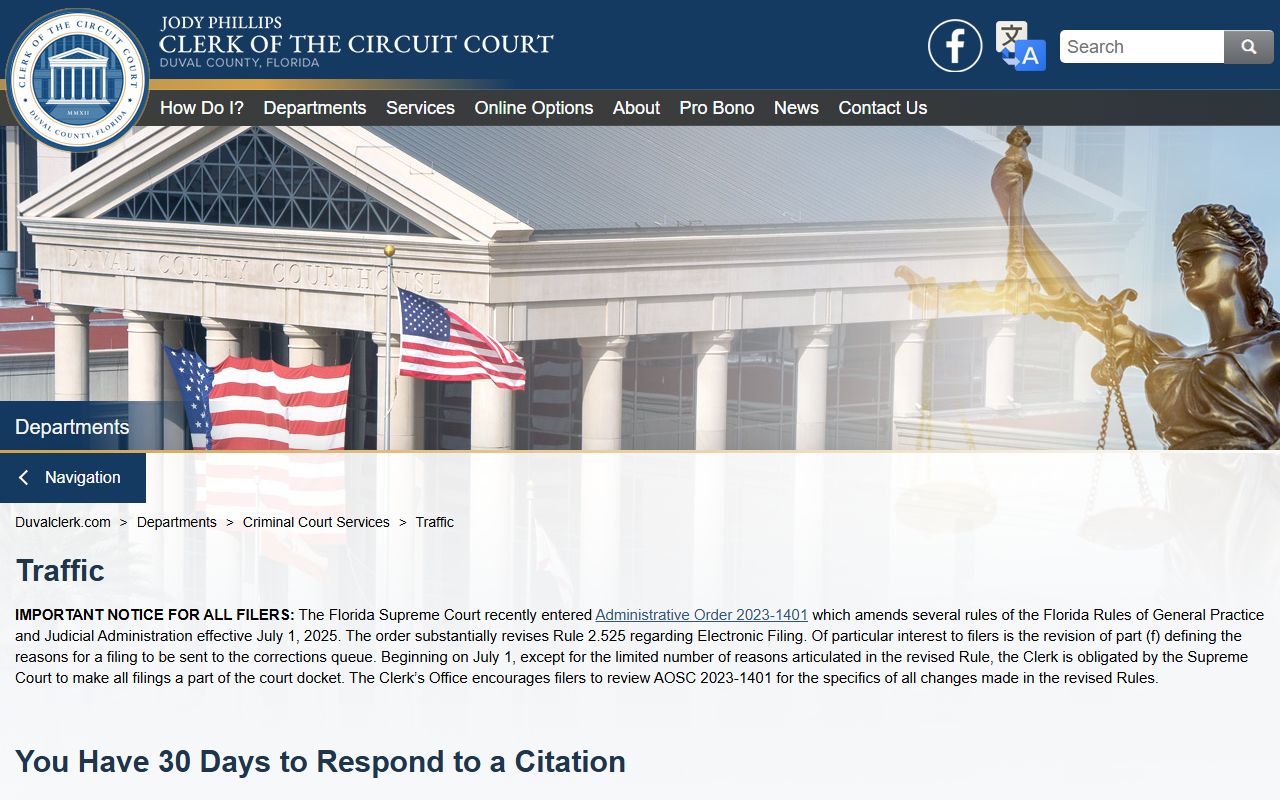
Online payment works within 30 calendar days of the citation issue date. After day 30, online payment is no longer available, and the citation must be paid in person at a Clerk office or by mail to the Traffic Violations Bureau. Paying the citation is treated as a conviction, and points may be assessed against the driver record. Driver Improvement School is an option for eligible civil citations, but CDL holders are not eligible. For deeper traffic detail, see the traffic court records page.
Small Claims and County Civil
Small claims is a simplified process for civil disputes under the small-claims cap. It is built so people can file without an attorney. The plaintiff files a statement of claim, pays the filing fee, and serves the defendant. A pre-trial conference is the first court date in most small claims cases. Many are settled at pre-trial; the rest move to trial before the county judge.
County civil covers higher-value disputes up to the statutory cap. Landlord-tenant matters, evictions, replevin, contract claims, and minor personal-injury actions are common. The fee schedule and filing forms are on the Clerk's site. Both small claims and county civil files are public records subject to the same redaction rules as other court files under Fla. Stat. § 119.0714.