
How to Search Duval County Traffic Court Records
The Duval Clerk handles traffic case lookup and ticket payment through the Clerk's Traffic Department page. The official portal for full case files is CORE, the Clerk Online Resource ePortal. Citation payment runs on a separate online payment tool linked from the Traffic page. The Traffic Violations Bureau, the office that processes the paperwork, sits at the main downtown courthouse on West Adams Street. The desk phone is (904) 255-2300.
Before you start, pull the paper citation out and find the issue date. The 30-day clock starts there. Florida sets the deadline at 30 calendar days from the issue date. After day 30 the online payment option closes, and the case may move to late status or even toward a license hold. Have the citation number, your full name, and date of birth ready.
- Open the Clerk Traffic page and click the online payment link.
- Enter the citation number exactly as printed on the ticket.
- Verify the driver name and date of birth on the screen.
- Pick the option that fits: pay, pay and elect school, request court date, or seek extension.
- Pay the fine plus any card-service fee, or follow the next-step link for school or court.
- Save the receipt; the Clerk emails confirmation to the address on file.
- For a full court case file, sign in to CORE and search by citation or case number.
The screenshot below shows the traffic options panel that loads from the Clerk's Traffic page. The image links back to the source page on the Clerk's traffic site.
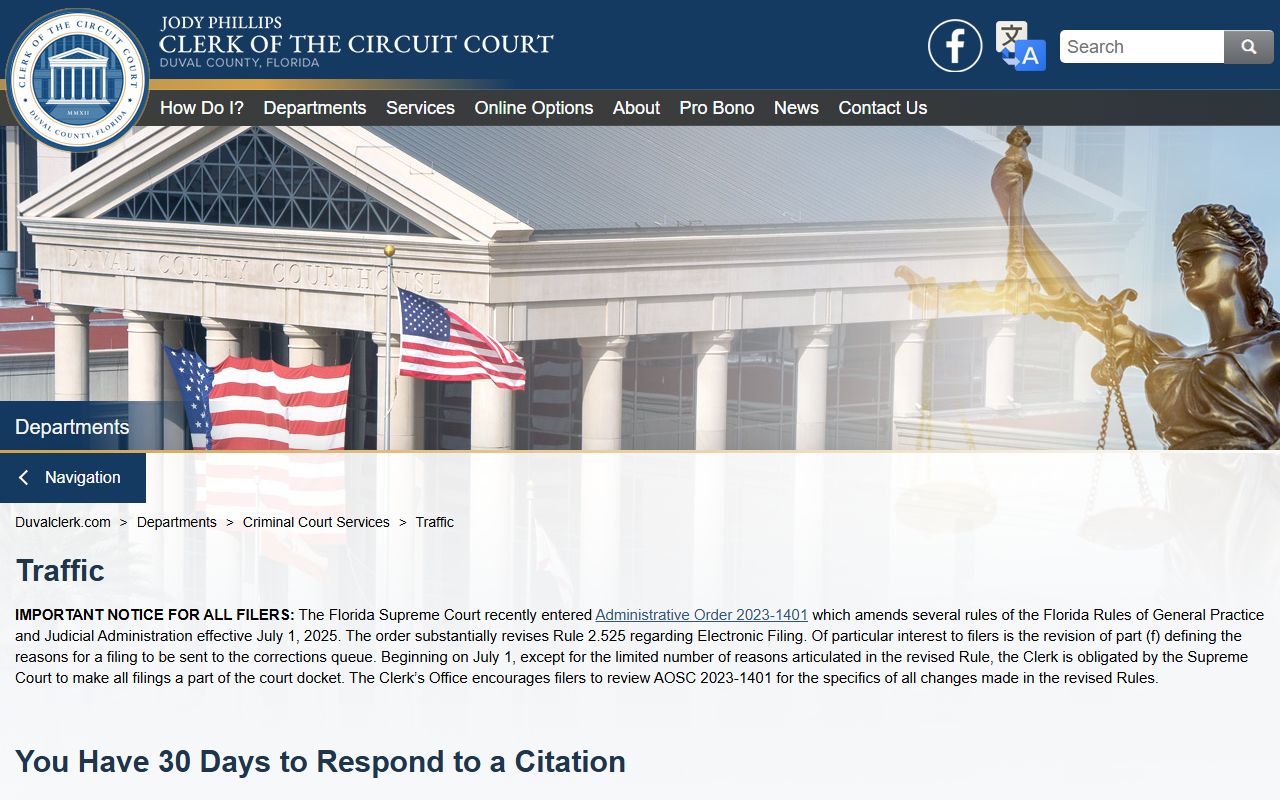
The panel breaks out the four standard paths a Duval driver can take after getting a citation. Each path has its own deadline and its own paperwork trail in the court file.
Note: Postmarks do not control mailed payment; the Clerk must receive the payment within 30 days of the citation issue date.
Which Courts Handle Traffic Cases in Duval County
Civil traffic infractions in Duval are handled by the County Court. The County Court is the trial court for misdemeanors, small claims, county civil, and civil traffic. Felony traffic matters, including most serious DUI cases with prior convictions or injury counts, move to the Circuit Court. The split is set by Florida law and the case type assigned to the citation. The Clerk's Traffic Department, sometimes called the Traffic Violations Bureau, is the office that intakes, dockets, and processes the paperwork on the Clerk side.
All three sit in the same downtown courthouse, the Duval County Courthouse at 501 West Adams Street in Jacksonville. The Traffic Violations Bureau is the public-facing desk for paying or contesting a civil citation. The desk line is (904) 255-2300. Hours run 8:00 a.m. to 5:00 p.m. on weekdays excluding holidays.
The Duval Clerk is the court records keeper for both trial courts. The Clerk's office files the citation, opens the court case if needed, and stores the docket. Florida judges, not Clerk staff, decide guilt or sanctions in contested cases.
Types of Traffic Cases on Record
Florida splits traffic into several buckets. Each one shows up as a different case type in the Clerk's file. Knowing the bucket helps a search land on the right docket.
- Civil traffic infractions. Speeding, red-light, stop sign, lane change, seat belt, and similar moving violations. Paid as a fine; no jail time.
- Non-moving violations. Equipment, registration, proof of insurance, and similar compliance items. Often dismissible with proof.
- Criminal traffic. Driving on a suspended license, leaving the scene, reckless driving, racing, and similar misdemeanors. Filed in County Court.
- DUI / DWI. Driving under the influence. First and second offenses usually misdemeanor; higher counts or injury move to felony in Circuit Court.
- Felony traffic. Vehicular homicide, DUI manslaughter, fleeing/eluding causing injury. Circuit-level cases with full criminal handling.
- Photo enforcement. Red-light camera notices and similar civil enforcement; handled as civil cases when contested.
- CDL-related cases. Citations issued to a commercial driver, with extra reporting rules under federal law.
Civil traffic citations are the most common file in the Clerk's traffic system. They are governed by Fla. Stat. § 316.650, the statute that sets out how citations are issued, transmitted, and processed.
What Duval County Traffic Court Records Show
A Duval traffic court record shows the path of a citation from issue to disposition. The Clerk keeps each entry, hearing, and order in a linked docket. Field availability shifts a bit by case type, but the core fields are consistent across civil traffic and criminal traffic files.
| Field | What It Shows |
|---|---|
| Citation Number | The number printed on the paper ticket; used for payment and lookup. |
| Case Number | Court case number opened when the citation moves into a court file. |
| Charge / Statute | Cited offense plus the Florida Statutes section that defines it. |
| Issuing Agency / Officer | Police agency and officer name on the ticket. |
| Issue Date | Date the citation was written; the 30-day clock starts here. |
| Due Date | Deadline for pay, school election, or court request. |
| Plea / Election | Pay, plea, election of Driver Improvement School, or request for hearing. |
| Hearing Date | If a court date is set, the date, time, and courtroom. |
| Fine and Costs | Fine amount, court costs, and any add-on fees. |
| School Election | Whether the driver elected Driver Improvement School. |
| Disposition | Final outcome: paid, dismissed, adjudicated, withhold, or court order. |
| FTA / FTP | Failure to appear or failure to pay flags if any. |
| Capias / Warrant | Any capias issued on criminal traffic cases for missed dates. |
Florida redacts personal data such as Social Security numbers, bank or card numbers, and protected-address info in the same way it does for other court files. Civil traffic files generally show up in the Clerk's public docket without sign-in for basic data.
Searching by Citation Number vs by Name
The fastest path is by citation number. The number is printed on the ticket, and the Clerk's payment portal is built around it. Name search is slower and may return more than one match. Date of birth helps narrow it. For full court files, CORE accepts both citation number and party name.
| Field Label | Type | Required | Notes |
|---|---|---|---|
| Citation Number | Text | Usually required for payment | Use the exact citation number from the paper ticket. |
| Case Number | Text | Optional | Used when the citation has become a court case. |
| Defendant / Driver Name | Text | Optional | Last name plus first; usable in CORE for the court case. |
| Date of Birth | Date | Identity check | Used when the payment portal verifies identity. |
| Driver License Number | Text | Portal-specific | FLHSMV uses DL to check license status, not Clerk payment. |
If the citation number is lost, the issuing officer's agency can sometimes verify it by date and driver name. The Clerk's Traffic line at (904) 255-2300 can also confirm the citation has reached the office.
Paying or Contesting a Duval County Traffic Ticket
A Duval driver who gets a civil citation has four choices. The clock is 30 days for all of them. Picking one rules out the others, so think through each path before you click pay.
- Read the citation. Find the issue date and the listed charge. Note the 30-day deadline.
- Decide which path fits: pay the fine, pay and elect Driver Improvement School, request a court date, or seek a payment extension.
- To pay online, open the Clerk's Traffic page and follow the online payment link before day 30.
- To pay in person, visit any Clerk's Office and pay by cash, money order, cashier's check, certified check, or card. Card payments carry a 3.5% non-refundable service fee.
- To pay by mail, send a money order, cashier's check, or certified check to the Traffic Violations Bureau at 501 W. Adams Street. Do not mail cash. The Clerk must receive the payment by day 30.
- To elect school, confirm eligibility first. CDL holders cannot use this option. The election is allowed once in any 12-month period and no more than five times in a lifetime.
- To contest, request a court date instead of paying. Paying is treated as a conviction, and after paying you cannot later elect school.
- To seek an extension, go to a Clerk office in person and submit a written request within the 30-day window. The Clerk can grant one 30-day extension; this waives the right to a court date.
Some compliance citations may be dismissed for $10 if the item was valid at the time of the stop. If proof is not available, a Proof of Compliance Affidavit can be filed for $7 in person within 30 days. Both options are handled at the Traffic Violations Bureau.
Watch the deadline. If day 30 passes without action, online payment closes, late fees apply, the case may move to court, and the state may move toward a license suspension. Acting before day 30 keeps every option open.
Public Access Laws for Traffic Court Records
Florida runs one of the broadest public records laws in the country. Civil traffic cases sit inside that open framework. The basic policy comes from Chapter 119, and the court-record carve-outs come from Florida Rule 2.420. The Duval Clerk applies both when posting traffic data online.
Statute callout:
Fla. Stat. § 119.07: Inspection, copying, fees, and reasonable conditions for public records.
Fla. Stat. § 316.650: Traffic citations: how they are issued, filed, and transmitted to the Clerk.
Fla. Stat. § 943.0585: Court-ordered expunction of eligible criminal history records.
Fla. Stat. § 943.059: Court-ordered sealing of eligible criminal history records.
Most civil traffic data is open to anyone. Personal data such as Social Security numbers, bank and card numbers, and certain protected-address information is redacted. Juvenile traffic matters and any sealed criminal traffic files sit outside the public view. See the public records page for the broader Chapter 119 framework.
Court Traffic Records vs State Driver Records
The Clerk's court file and the state driver record are not the same thing. They live in two different systems and answer two different questions. The court file shows what happened in the case. The driver record shows what the state recorded against the license after the case closed.
| Court Traffic Record | State Driver Record |
|---|---|
| Source: Duval Clerk / Traffic Violations Bureau / CORE. | Source: Florida Department of Highway Safety and Motor Vehicles (FLHSMV). |
| What's in it: Citation number, charge, statute, plea, hearing, fine, election, disposition, FTA/FTP flags. | What's in it: License status, points, suspensions, revocations, convictions reported by the courts, CDL endorsements, crash entries. |
| Where to access: Clerk Traffic page and CORE; in-person at 501 W. Adams Street. | Where to access: FLHSMV Driver License Check for status; official transcripts through FLHSMV channels. |
| Who maintains it: Duval Clerk under Fla. Stat. § 28.24 and Rule 2.420. | Who maintains it: FLHSMV under Florida driver-record statutes. |
| How to correct errors: File a motion in the court case or contact the Clerk's traffic desk. | How to correct errors: Contact FLHSMV Driver License Services with proof from the court file. |
The screenshot below shows the FLHSMV license check tool. The lookup links back to the official FLHSMV Driver License Check page.
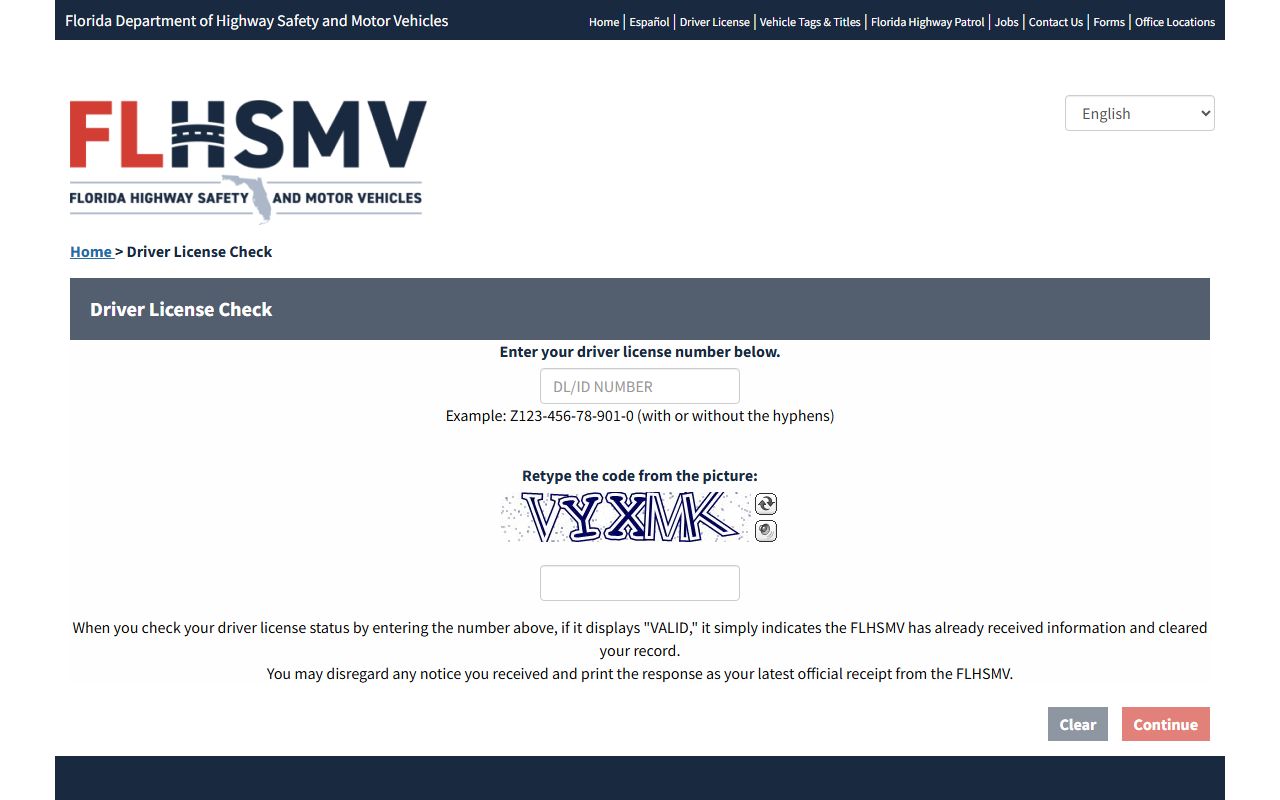
The state portal returns the current license status but not a full transcript. A full driver record transcript needs a separate FLHSMV request.
CDL and Commercial Driver Records
A commercial driver's license carries extra weight. Federal law treats CDL holders under stricter rules, and Florida builds those rules into how the court and the state handle a citation. A CDL driver does not get every option a regular driver has.
CDL holders are not eligible to elect Driver Improvement School in Duval. The school election removes points from the driver record, and federal CDL rules block that path. A CDL driver who wants to avoid a conviction has to ask for a court date and contest the citation. Paying is still treated as a conviction, and convictions on a CDL holder get reported to the federal database.
The court file shows the citation and disposition the same way it would for a regular driver. The state driver record is where the CDL treatment shows up, with reporting to FLHSMV and through FLHSMV to federal partners. Drivers in this group should consider a traffic attorney before paying.
DUI / DWI Cases
Florida calls the charge driving under the influence. DUI is not a civil traffic case. It is filed as criminal traffic, and it moves through the criminal docket. First and second DUI offenses are misdemeanors handled in County Court. Higher counts, DUI with injury, and DUI manslaughter are felonies handled in Circuit Court.
Because DUI is criminal, the case shows up alongside other criminal records. Bond, arraignment, plea, and sentencing follow the standard criminal path. For arrest data, JSO booking detail, and the broader criminal flow, see the criminal records page. For active warrants linked to a missed DUI hearing, see the warrant records page.
Deferred Adjudication and Defensive Driving Course
Florida does not use the phrase defensive driving in its court files. The state calls it Driver Improvement School, or DIS. The school is the closest thing the Clerk offers to deferred adjudication on a civil traffic ticket. Completing school after paying the fine keeps the citation off the driver record as a point-bearing conviction.
The election rule is set by Florida law. A driver can elect school once in any 12-month period. The lifetime cap is five elections. CDL holders are blocked from the election entirely. To use the option, the driver pays the citation in full, elects school at the time of payment, and completes a state-approved course within the deadline set by the court.
Once school is complete, the certificate gets reported back to the court file. The court file shows the election and the completion. The driver record at FLHSMV does not get the point assessment that a straight payment would trigger. The screenshot below shows the Florida statute that anchors traffic citation handling, linked back to Fla. Stat. § 316.650.
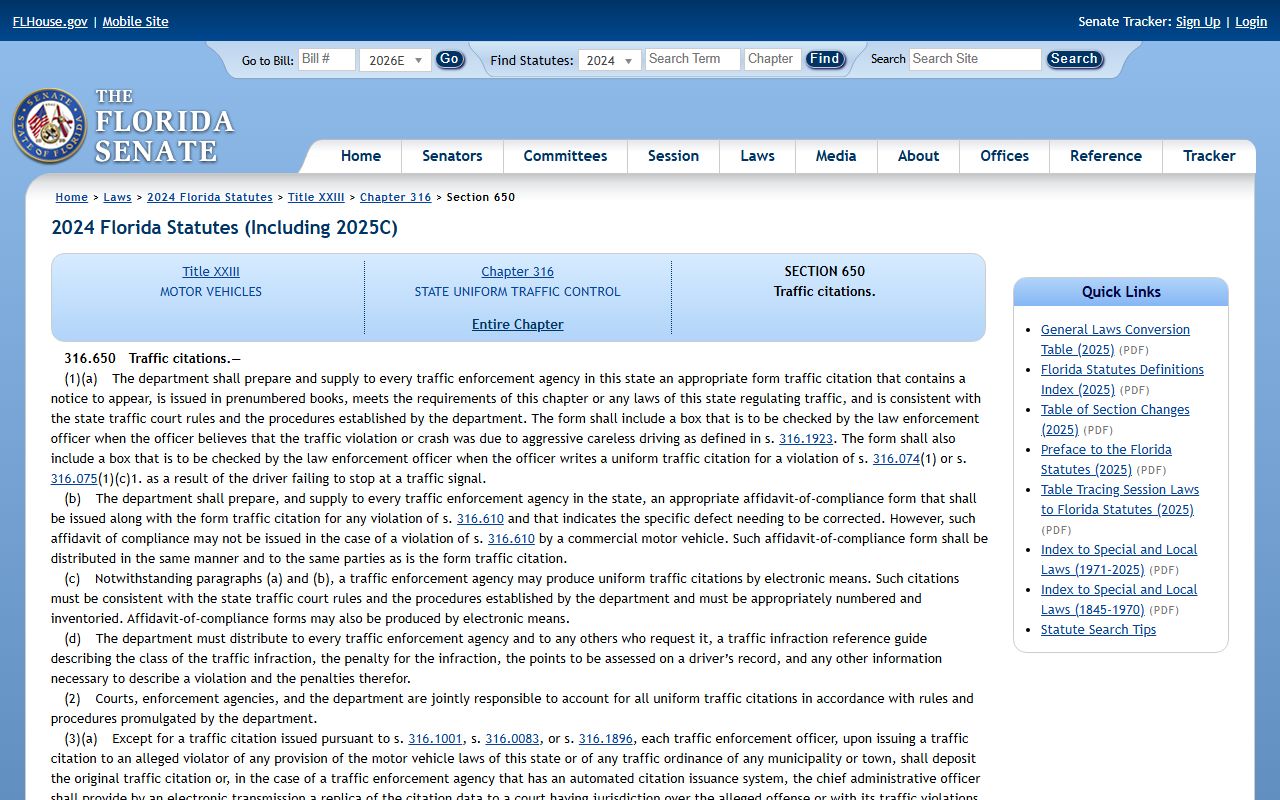
The statute is the framework for how citations get filed, transmitted to the Clerk, and processed through the court system.
Note: Paying a citation is a conviction; once paid, the driver cannot later elect school for the same ticket.
Sealing or Expunging Traffic Records
Most civil traffic cases stay public. Florida law does not allow sealing or expunction of a civil citation in the way it allows for criminal cases. A paid civil ticket is treated as a conviction and remains in both the court file and on the driver record at FLHSMV.
Criminal traffic cases are different. A driver charged with a criminal traffic offense, such as driving on a suspended license or reckless driving, can apply for sealing or expunction under Fla. Stat. § 943.0585 and Fla. Stat. § 943.059 if the offense and the disposition qualify. Eligibility runs through the Florida Department of Law Enforcement before the court order is filed. The Clerk processes the order once a judge signs it.
The Clerk's forms library includes seal or expunge packets. Petitioners should expect to file a petition, affidavit, proposed order, and FDLE certificate if the process calls for one. See the court records page for more on the broader sealing process.
Fees for Traffic Record Copies
The Clerk charges set fees for traffic copies, certifications, and a few traffic-specific actions. The schedule is set by Fla. Stat. § 28.24 and posted on the Clerk's fee schedule page.
| Item | Amount |
|---|---|
| Plain copy per page (standard size) | $1.00 |
| Certified copy per instrument | $2.00 |
| Dismissal of dismissable citation (item valid at time of stop) | $10.00 |
| Proof of Compliance Affidavit fee | $7.00 |
| Card-service surcharge in person | 3.5% |
| Records search per year | $2.00 |
Fines on the citation itself are set by Florida law and vary by charge. Court costs and small statutory add-ons sit on top of the base fine. For older traffic files that predate the online system, the Clerk's research desk can pull paper records on request.