
How Duval County Criminal Records Are Organized
Duval criminal records sit in two main systems. Court case files live with the Duval Clerk and are searched through CORE. Booking and custody data live with the Jacksonville Sheriff's Office and are searched through JSO Inmate Information Search. The two systems link at the booking and case stage, but they answer different questions. CORE shows the court case. JSO shows custody and the booking event.
Felonies are filed in Circuit Court under the Fourth Judicial Circuit. Misdemeanors and county criminal cases are filed in County Court. State prosecution comes through the Office of the State Attorney for the Fourth Judicial Circuit. Indigent defense comes through the Office of the Public Defender for the same circuit. A criminal case may start with an arrest in the field, a direct file by the State Attorney, or a grand jury indictment.
Note: An arrest is an accusation; only a court disposition decides guilt under Florida law.
How to Search Duval County Criminal Records
The fastest way to pull a Duval criminal record is to start with the name and date of birth. The Clerk's case portal and the JSO inmate tool both accept name search. A case number speeds the result if you have one. A booking number works for recent custody. The two tools split the lift: court history through CORE, custody history through JSO.
- Open CORE at core.duvalclerk.com and clear any captcha shown.
- Sign in with a free CORE account or use public access for the docket view.
- Pick the criminal search window and type the case number or party name.
- Filter by case type and filing year to trim a long result list.
- Open the case to read charges, plea, sentence, and the docket history.
- Open the JSO Inmate Information Search for booking, mugshot, charges, and bond.
- Cross-check the two tools by name and date of birth to confirm a match.
- Order an eCertified copy from CORE if you need a Clerk-stamped record.
The JSO inmate tool reaches current and historical custody. The system exposes endpoints for search by name, search by booking number, recent bookings, and release log. The public site adds a captcha for some queries. The JSO Inmate Information page links the live search and explains how to verify a release.
A view of the State Attorney's public homepage sits below. The office posts case news, victim resources, and public records request links for circuit prosecutions.
For prosecution and victim resources, see the Office of the State Attorney for the Fourth Judicial Circuit.
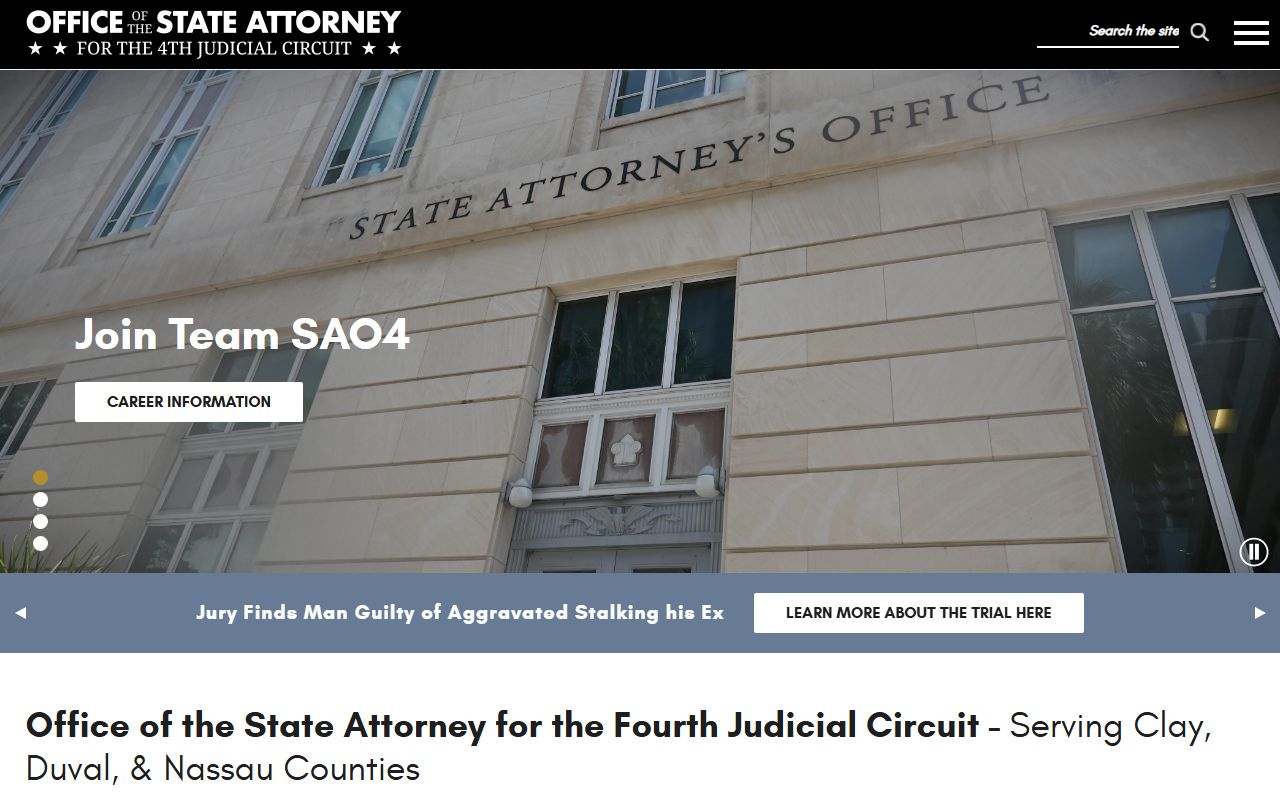
The State Attorney is Melissa W. Nelson. The office prosecutes state criminal cases across Duval, Clay, and Nassau counties from 311 West Monroe Street in Jacksonville.
Types of Duval County Criminal Records
Criminal records in Duval split by court level and by case stage. The list below covers the main groups. Each group has its own docket format and access rules. Some types share charging instruments; others split by the level of the court.
- Felony case records. Filed by the State Attorney as an information or by a grand jury as an indictment. Filed in Circuit Court.
- Misdemeanor case records. Filed by the State Attorney in County Court for charges below felony level.
- Arrest and booking records. Maintained by JSO. Cover intake, charges at booking, mugshot, and custody status.
- Capias and warrant entries. Court-issued orders for failure to appear or after charging. See warrant records.
- Bond and pretrial release records. Cash, surety, or release on recognizance entries posted to the case.
- Disposition records. Plea, trial result, withhold of adjudication, conviction, or dismissal.
- Probation and post-conviction records. Probation orders, violation affidavits, and modification orders.
Juvenile delinquency records are not in the ordinary CORE public view. They are restricted under Fla. Stat. § 985.04 and the juvenile court rules.
What a Duval Criminal Record Contains
A criminal case file in Duval pulls together every step from arrest to sentence. The fields shift slightly by case level. Felony files carry more documents than a simple misdemeanor traffic-related case. The list below covers the standard fields a reader meets on a CORE criminal case page.
| Field | What It Shows |
|---|---|
| Case Number | Year, court level, criminal division code, and sequence. |
| Filing Date | Date the charge was filed with the Clerk. |
| Defendant | Name, date of birth, and identifiers as filed. |
| Charges | Statute, charge label, degree, and count. |
| Arresting Agency | JSO or other agency that booked the defendant. |
| Bond | Type and amount; cash, surety, or no bond. |
| Plea | Guilty, not guilty, or no contest, with date. |
| Disposition | Conviction, withhold, dismissal, or trial result. |
| Sentence | Jail, prison, probation, fines, restitution, conditions. |
| Judge and Division | Assigned judge and felony or misdemeanor division code. |
| Docket Entries | Filings, motions, orders, hearings in date order. See court dockets. |
| Redactions | Victim data, juvenile names, SSN, bank, and card numbers. |
Mugshots taken at booking are part of the JSO record. The court file does not always carry the booking photo. The JSO search shows mugshot, charges at booking, height, weight, eye color, hair color, and next court date when set.
Charges vs Convictions in Duval Records
A charge is not a conviction. The two appear on different parts of the same record but mean very different things in Florida law. A charge starts the case. A conviction ends it. Reading the docket without this split leads to mistakes. The Clerk records both events but does not change one into the other.
| Charges | Convictions |
|---|---|
| Filed by the State Attorney or grand jury | Entered by the court after plea or trial |
| Listed on the booking sheet and on the case page | Listed in the disposition section of the docket |
| Public, but presumed innocent until adjudicated | Public, with a formal adjudication of guilt |
| May be amended, dropped, or nolle prossed | Final unless reversed on appeal or post-conviction motion |
| Do not trigger sentencing | Trigger sentencing under Florida law |
Florida also recognizes a withhold of adjudication. The court holds back the formal adjudication subject to conditions. The defendant is not labeled a convicted person for many purposes, though the record stays in the case file. Withhold dispositions appear in the disposition row of the docket and can affect later sealing eligibility.
Sealed vs Expunged in Duval
Florida lets eligible people seal or expunge a criminal record. The two are not the same. Eligibility runs through the Florida Department of Law Enforcement before the order is filed in the case. The court file is then restricted by Clerk staff. The Duval Clerk fee for sealing or expungement is $59.
| Sealed Record | Expunged Record |
|---|---|
| Restricts public access; case file still exists | Erases qualifying record from public access more fully |
| Governed by Fla. Stat. § 943.059 | Governed by Fla. Stat. § 943.0585 |
| Visible to law enforcement and certain agencies | Visible to a narrower set of agencies |
| Person may lawfully deny the sealed event in most cases | Person may lawfully deny the expunged event in most cases |
| FDLE certificate of eligibility usually required first | FDLE certificate of eligibility usually required first |
Juvenile criminal history follows its own retention and expunction track under Fla. Stat. § 943.0515. The Clerk maintains a separate forms category for seal and expunge requests.
Public Access Laws for Criminal Records
Florida's public records framework reaches criminal court files. The general open records policy sits in Fla. Stat. § 119.01. The inspection and copying rule sits in Fla. Stat. § 119.07. The court file privacy rule sits in Fla. Stat. § 119.0714 and supports redaction of SSN, bank, and card numbers. The judicial branch rule, Florida Rule 2.420, sets the matrix for online court access.
JSO booking data is public under Chapter 119 once the booking is complete. Mugshots appear on the JSO public search. Active investigation files held by JSO or the State Attorney may carry exemptions. Victim information in sexual offense and child abuse cases is restricted by statute. Mental health intake records remain confidential under Fla. Stat. § 394.4615.
Important. Online viewing of a charge does not mean a person was found guilty. Read the disposition section before sharing what the case file shows.
Note: Sealed and expunged cases must not be displayed in public criminal record listings; remove the entry if a court order has been entered.
State Attorney and Public Defender
Florida calls its lead prosecutor the State Attorney, not the District Attorney. The Office of the State Attorney for the Fourth Judicial Circuit serves Duval, Clay, and Nassau counties. The office sits at 311 West Monroe Street, Jacksonville, FL 32202-4242. The main phone line is (904) 255-2500. State Attorney Melissa W. Nelson took office in January 2017 and leads more than 300 attorneys, investigators, and staff.
On April 15, 2026, the State Attorney designated Assistant State Attorney Joy Whitmore as the Fourth Circuit's first Internet Crimes Against Children prosecutor. The role leads search warrants, arrest warrants, and active Chapter 847 cases, plus computer-related Chapter 827 crimes across the circuit. The change shapes how Internet-based child exploitation cases are filed and prosecuted in Duval.
The Office of the Public Defender for the Fourth Judicial Circuit handles indigent defense for the same three counties. The Duval office sits at 407 N. Laura Street, Jacksonville, FL 32202. The main line is (904) 255-HOPE. Public Defender Charlie Cofer leads the office. Florida law gives a person charged with a crime the right to appointed counsel when they cannot afford a lawyer.
Background Checks and Record Limits
A Duval CORE search is not a Florida criminal history check. A statewide criminal history check runs through FDLE. A federal background check runs through the FBI. Employers and licensing boards often use FDLE or the federal NCIC channel rather than a single-county lookup. A Duval search is local and useful for in-county case detail.
This site is not a consumer reporting agency. The data on the page is for general public use, not for credit, employment, tenant, insurance, or other FCRA-regulated decisions. Florida law sets the source records, and the originating government office controls the official copy.
For a Duval-only check, run the CORE search by name plus date of birth. Cross-check the result with the JSO Inmate Information Search for booking history. For a Florida-wide check, run the FDLE name-based criminal history search and pay the state fee. For a federal check, run the FBI Identity History Summary through the FBI's official channel. Each check answers a different question. A Duval result does not show out-of-county felony cases. A statewide result does not show federal cases. A federal result does not show state-court history. Use the right tool for the question.
Note: Older criminal records may need help from the Clerk's research room; cases before 1988 often need staff lookup rather than online viewing.